Building an AI agent that posts to social media sounds simple until you try it. The hard part is not the model, it is the plumbing. Developers say it plainly on Reddit: they want to build "a social media agent without dealing with every platform API," and they keep "getting accounts banned" trying to wire it up themselves. This guide is about what an AI agent actually needs from a social media API, and how that differs from a normal one.
Why agents need a different kind of API
A traditional social API assumes a human is in the loop: a developer reads the docs, handles each error, and adjusts. An AI agent has none of that. It calls a tool, gets a response, and must decide the next step on its own, with no person to interpret a cryptic failure.
That changes what "good" means. For an agent, the API has to be:
- Discoverable. The agent should be able to see what actions exist and what inputs they take, ideally from the schema itself.
- Predictable. One consistent shape for requests and responses across every network, not a different model per platform.
- Self-correcting. Errors must be structured enough that the agent can fix its own input and retry.
Most social APIs were not built with any of that in mind, which is exactly why so many agent projects stall.
What an AI agent actually needs
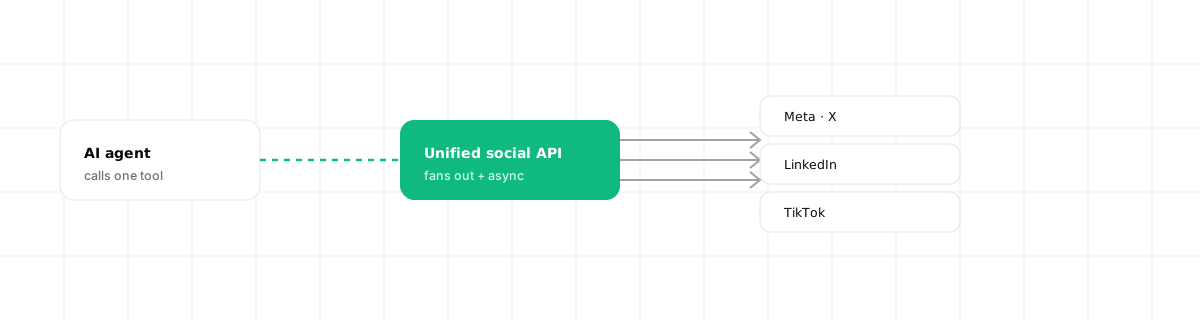
Concretely, a social media API built for agents should give you:
- A unified endpoint. One call to publish, instead of one integration per network. The agent should not have to know that Instagram uses a two-step container flow and X uses a different one.
- Clear tool definitions. Names, input parameters, and output schemas the agent (or an MCP client) can read and call without guesswork.
- Async delivery with status. Posting is queued and the agent gets a job id it can poll, so one slow network does not block the run.
- Structured, machine-readable errors. The single most important property, covered next.
First the agent discovers what it can post to. One call lists the connected accounts and their ids, so the agent never hardcodes a target:
curl https://api.dravo.dev/v1/accounts \
  -H "Authorization: Bearer $DRAVO_API_KEY"
# => { "items": [
#        { "id": "acc_8f2c1d", "platform": "x", "handle": "@dravo", "health": "active" },
#        { "id": "acc_4b9e07", "platform": "linkedin", "handle": "Acme Inc", "health": "active" }
#      ], "total": 2 }
Then it publishes to the ids it picked, fanning out to every network in one call:
curl -X POST https://api.dravo.dev/v1/posts \
  -H "Authorization: Bearer $DRAVO_API_KEY" \
  -H "Content-Type: application/json" \
  -d '{
    "account_ids": ["acc_8f2c1d", "acc_4b9e07"],
    "text": "Posted autonomously by an agent."
  }'
# => 202 Accepted, { "id": "post_2a7f93", "status": "queued", "scheduled_at": null }
The agent targets connected accounts by their acc_… ids (it can discover them
with GET /v1/accounts) rather than platform names, so one call fans out to
every network the agent should publish to. Delivery is async: the agent gets a
post id back and polls GET /v1/posts for the per-account outcome.
Errors an agent can fix by itself
This is the difference that makes or breaks an autonomous workflow. A human can read "400 Bad Request" and figure it out. An agent cannot, unless the error tells it exactly what went wrong in a form it can parse.
Compare a vague failure with a structured one. Dravo records the outcome per account in the publish history, so the agent reads exactly which account failed and why:
{ "account_id": "acc_8f2c1d", "platform": "linkedin", "status": "failed", "platform_post_id": null, "error_code": "media_too_large", "error_message": "Image exceeds LinkedIn's size limit.", "raw_response": { }}With that, the agent reads the stable error_code, acts on the human-readable
error_message, shrinks the image, and retries, no human involved. raw_response
keeps the untouched platform payload for deeper debugging. That is what "AI-native
errors" means in practice, and it is the property to insist on when you evaluate
any social API for agents.
BYOK: the agent acts on your accounts
There is a trust dimension too. If your agent publishes through a vendor's shared app credentials, you inherit their rate limits and their risk: if the vendor's app gets flagged, every customer's agent goes down.
A BYOK (Bring Your Own Keys) model fixes this. You connect your own platform developer apps, and the agent acts on your own accounts, with your own rate limits and your direct relationship with each platform. For an autonomous system that may run unattended, that isolation matters: a problem with one tenant cannot cascade to yours.
Reading results back: analytics the agent can act on
Publishing is only half of an autonomous loop. An agent that decides what to post next needs to read how the last post did, and it needs those numbers in the same machine-readable shape as everything else. A unified analytics endpoint gives the agent official platform metrics without scraping or a separate integration per network:
curl "https://api.dravo.dev/v1/analytics/posts?postId=post_2a7f93" \
-H "Authorization: Bearer $DRAVO_API_KEY"{ "items": [ { "post_id": "post_2a7f93", "account_id": "acc_8f2c1d", "platform": "instagram", "metrics": { "views": 1240, "reach": 980, "likes": 84, "comments": 6, "shares": 12 }, "sync_status": "synced", "last_updated_at": "2026-06-29T09:00:00Z" } ], "total": 1, "page": 1, "limit": 25, "overview": { "posts": 1, "metrics": { "views": 1240, "reach": 980, "likes": 84, "comments": 6, "shares": 12 } }}The agent reads the metrics object the same way across every network, checks sync_status to know the numbers are fresh, and feeds them back into its next decision. Profile-level numbers (followers, reach, views) come from the companion GET /v1/analytics/accounts endpoint. That closes the loop: publish, measure, adjust, all over one structured API.
REST API or MCP server?
You will see two shapes for "social API for agents," and they are complementary:
- A REST API. The agent (or your code around it) calls HTTP endpoints. Best when you control the agent's tool layer.
- An MCP server. The Model Context Protocol exposes the same actions as tools an MCP client (Claude, Cursor, ChatGPT) can discover and call directly. MCP's primitives are tools (executable actions), resources (read-only data), and prompts, all over JSON-RPC.
If you are building a custom agent, the REST API is direct. If you want an off-the-shelf client like Claude to post for you, an MCP server is the bridge. We cover that path in what an MCP server is.
How Dravo fits
Dravo is a unified social media API built for exactly this: one POST /v1/posts fans out to every network, posting is async with a post id you poll, official metrics come back from one GET /v1/analytics/posts endpoint, and every error is structured so an agent can self-correct. It uses a BYOK model, so your agent acts on your own accounts and keys. The design maps cleanly onto MCP tools, so the same actions an agent calls over REST can be exposed to an MCP client.
If you are wiring up an autonomous publisher, that removes the per-platform integration work and the unreadable-error problem in one move. To see the per-network reality an agent would otherwise handle itself, read the Instagram API, LinkedIn API, X (Twitter) API, and TikTok API guides, and for the ownership model behind BYOK, white-label social media management.
Frequently asked questions
What is a social media API for AI agents? It is a programmatic interface that lets an autonomous AI agent publish, read, and manage social media content across networks without a human in the loop. The key difference is that schemas and errors are machine-readable, so the agent can call tools and recover from failures on its own.
How do I let an AI agent post to social media? Give the agent a unified social media API with clear tool definitions (publish, check status, list accounts) and connect your own platform credentials. The agent calls the publish endpoint or an MCP tool, the API fans the post out, and the agent acts on the status returned.
Can I build a social media agent without integrating every platform API? Yes. A unified API abstracts Meta, X, LinkedIn, TikTok and others behind one endpoint, so your agent calls one interface instead of maintaining a separate OAuth flow, payload format and error model per network.
Why do machine-readable errors matter for AI agents? Because an agent has no human to read a stack trace. If a failure returns a structured message that names the field, the reason, and the fix, the agent can correct its own input and retry. Vague errors force the agent to give up or loop.