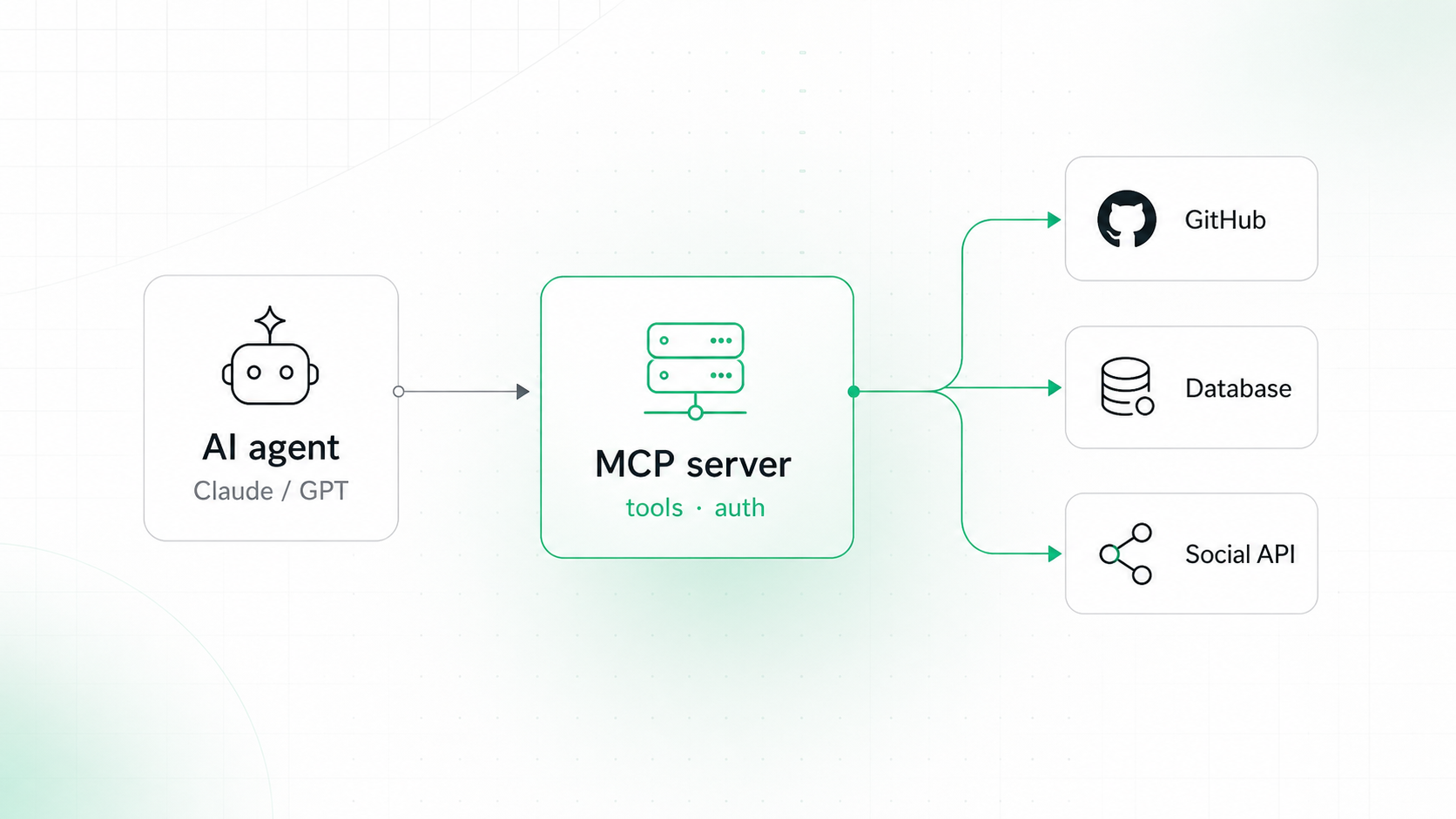
If you have spent any time around AI agents lately, you have run into the term MCP server, usually with no clear explanation of what it actually is. People on Reddit literally ask, "Explain MCP like I am 10 years old." This guide gives the plain version, then shows where it gets useful, including what a social media MCP server lets an AI agent do.
What is an MCP server, in one sentence
An MCP server (Model Context Protocol server) is a standardized bridge that securely connects an AI model to external tools, data, and APIs. It acts as a universal adapter: it takes the AI's request, handles authentication, talks to the real system (GitHub, a database, an API), and sends the result back.
MCP itself is an open standard, introduced by Anthropic in late 2024 and adopted across the industry. The common analogy is good: MCP is like USB-C for AI. One standard plug, instead of a different cable for every device.
Host, client, server: how the pieces fit
There are three roles, and mixing them up is where most confusion comes from.
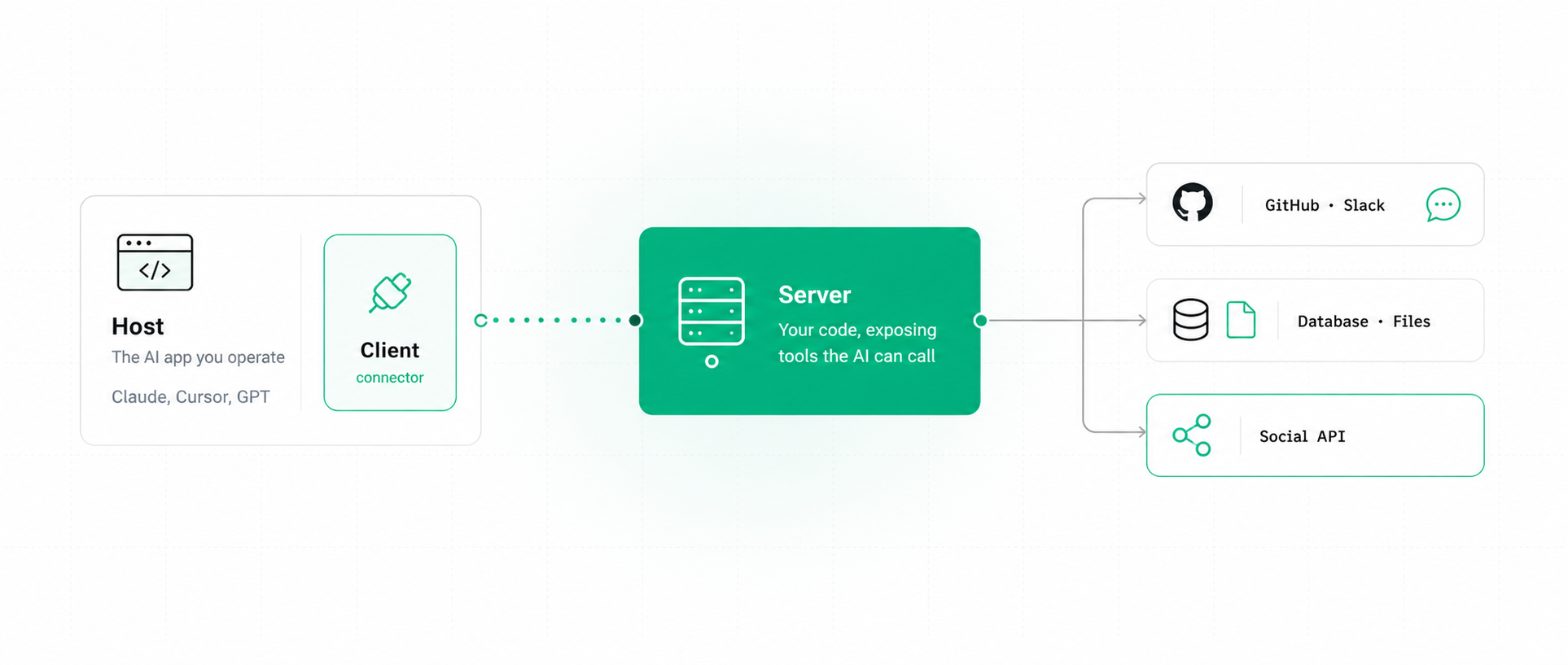
- Host. The AI app you actually open: Claude Desktop, ChatGPT, Cursor, or your own chatbot. The model runs here.
- Client. The connector that lives inside the host. It routes tool calls out and brings results back.
- Server. Your code, wrapping a real system and exposing it as tools the AI can call.
The flow is simple. When the host starts, the client asks every connected server "what can you do?" and the servers reply with a list of tools. When you type a question, the model decides which tools to call, the server hits the real API, live data comes back, and the model writes the answer. Underneath it all is JSON-RPC 2.0. Nothing exotic.
MCP vs API: what's the difference
This is the most common follow-up question, so let's be precise.
An API is a fixed interface: defined endpoints that software calls in a specific way. You write integration code against it.
An MCP server wraps one or more APIs in a standardized layer that an AI model can discover and use automatically, without you writing custom integration code for each model and each tool. The API is still there underneath; MCP is the AI-friendly envelope around it.
The math is the reason it matters. Without MCP, connecting N models to M tools means building a custom bridge for every pair: N times M. With MCP in the middle, it is N plus M. One protocol, far fewer integrations.
Why developers use MCP servers
- Reusability. Write the connection to GitHub, Postgres, or Drive once, and any MCP-compatible agent or platform can reuse it.
- Security. Instead of handing the model raw access to your whole system, the server is a controlled gateway that handles permissions and scoping.
- Standardization. One plug-and-play language, so you stop dealing with different headers, tokens, and formats for every service.
Common examples of MCP servers
The ecosystem already covers the obvious ground:
- Databases. Let an agent safely query and analyze internal data.
- File systems. Let an agent read, write, and reference local files.
- Applications. Official servers for GitHub, Slack, and Docker let an agent take actions inside those tools.
These cover developer infrastructure. The faster-growing category is servers that let agents act on the outside world, which is where social media comes in.
A social media MCP server
Here is the use case closest to home. A social media MCP server exposes social publishing as tools an AI agent can call. Instead of switching to a dashboard, you tell your AI client what to post, and it does it.
That means an agent can call tools like publish_post, check_post_status, or list_accounts across networks, the same way it calls a GitHub or database server. The actions are model-controlled: the AI decides when to publish, based on your instruction.
This is exactly the direction Dravo is built for. Dravo is a unified social media API on a BYOK (Bring Your Own Keys) model: one call publishes to Meta, X, LinkedIn and more, with structured, machine-readable errors so an agent can self-correct. The API is designed so it maps cleanly onto MCP tools, letting an AI client post on your behalf while your accounts and keys stay yours. For the background on the model, see our guide on white-label social media management. To see the per-platform reality an agent would otherwise have to handle itself, read how publishing works with the Instagram API, the LinkedIn API, the X (Twitter) API, and the TikTok API.
If you are building agents that need to publish, an API with clean schemas and parseable errors is what makes the MCP layer reliable, because the agent reads the error and fixes its own input. For the publishing angle specifically, see our guides on a social media MCP server, a social media API for AI agents, and how to post to social media from Claude.
Frequently asked questions
What is an MCP server in simple terms? An MCP server is a standardized bridge that connects an AI model to external tools, data, and APIs. It exposes actions the AI can call, handles authentication, talks to the real system, and returns the result. Write it once and any AI client that speaks MCP can use it.
What is the difference between an API and an MCP server? An API is a fixed interface for software to call. An MCP server wraps one or more APIs in a standardized layer that an AI model can discover and use automatically, without custom integration code for each model. MCP is often described as USB-C for AI.
Does ChatGPT use MCP? Yes. MCP is an open standard introduced by Anthropic and adopted across the ecosystem. AI clients including Claude, ChatGPT, Cursor and others can connect to MCP servers to use external tools.
Why would I need an MCP server? If you want an AI agent to take real actions (query a database, post to social media, open a pull request) rather than just chat, an MCP server is how you expose those actions safely and reusably to any MCP-compatible client.