If you want an AI assistant to actually post to your social accounts rather than just draft text, a social media MCP server is the missing piece. People are already asking for it directly, with Reddit threads titled "an MCP server for social media management." This guide explains what one is, the tools it exposes, and how to connect it to Claude, Cursor or ChatGPT.
What is a social media MCP server
A social media MCP server is a Model Context Protocol server that exposes social publishing and management as tools an AI client can call. MCP is the open standard that lets an AI application discover and use external capabilities; a social media MCP server applies it to posting.
The practical effect: you skip the dashboard. You tell your AI client "post this to X and LinkedIn," and the client calls the server's tools to do it. The server handles authentication, talks to each network, and returns a result the AI can act on.
The tools it exposes
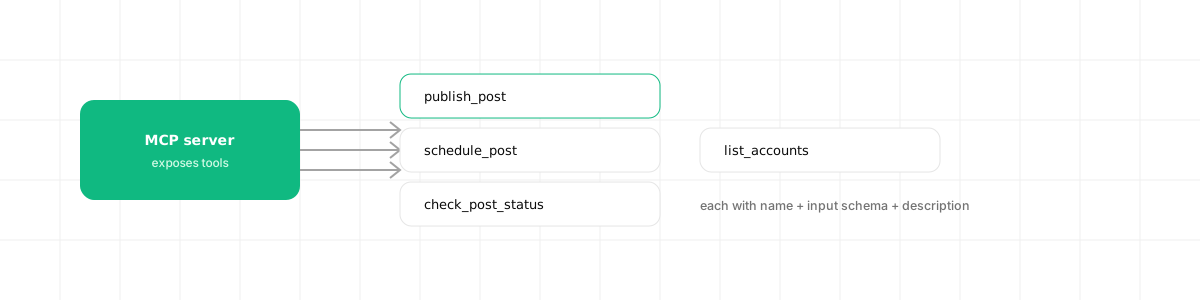
Under MCP, a server exposes three kinds of primitive: tools (executable actions), resources (read-only data addressable by URI), and prompts (reusable templates). A social media MCP server is mostly tools. A typical set:
publish_post: publish content to one or more networks now.schedule_post: queue a post for a future time.check_post_status: look up the delivery status of a job.list_accounts: see which connected accounts are available.
Each tool is defined with a name, input schema, output schema, and description, so the AI client can discover what exists and call it correctly. That discoverability is the whole point: the agent reads the tool list before you even type a request.
How it maps onto a unified API
An MCP server is a thin, AI-friendly layer. Underneath, it still has to actually publish, and that is where a unified social media API comes in.
The cleanest design is: one API endpoint per action, and one MCP tool that wraps it. So publish_post calls the API's publish endpoint, which fans the content out to Meta, X, LinkedIn and others. This is why a well-designed API with clear schemas and parseable errors makes for a reliable MCP server: the agent calls the tool, the tool calls the API, and any failure comes back structured enough for the agent to fix and retry.
The protocol plumbing is standard: MCP speaks JSON-RPC 2.0 over stdio or HTTP, with a host-client-server architecture. The host is the AI app, the client is the connector inside it, and the server is your code. We break that down in what an MCP server is.
Connecting it to Claude or Cursor
Because MCP is an open standard, the same server works across clients. The flow is the same everywhere:
- The MCP client (Claude, Cursor, ChatGPT) is configured to connect to the server.
- On startup, the client asks the server for its tool list.
- When you ask the client to post something, it calls the matching tool with the right arguments.
- The server publishes and returns a status the client reports back to you.
No dashboard, no copy-paste. You describe the post in natural language and the agent carries it out.
BYOK keeps the accounts yours
A social media MCP server should publish on your accounts, not a vendor's shared app. With a BYOK (Bring Your Own Keys) model, you connect your own platform credentials, so the agent acts with your rate limits and your direct platform relationship. If a shared vendor app were flagged, every user's agent would break; BYOK isolates you from that.
How Dravo fits
Dravo is a unified social media API on a BYOK model, designed so its actions map cleanly onto MCP tools: one publish action fans out to every network, posting is async, and every error is structured so an agent can self-correct. That makes it a solid foundation for a social media MCP server, where the AI client calls a tool, the tool calls Dravo, and your accounts and keys stay yours.
If you are building agents that publish, start from the social media API for AI agents overview, and for per-network detail see the Instagram, LinkedIn, X and TikTok guides.
Frequently asked questions
What is a social media MCP server? It is a Model Context Protocol server that exposes social media publishing and management as tools an AI client can call. Instead of opening a dashboard, you tell Claude, Cursor or ChatGPT what to post, and the server carries out the action across one or more networks.
What tools does a social media MCP server expose? Typically actions like publish_post, schedule_post, check_post_status, and list_accounts, each defined with a name, input schema and description so the AI client can discover and call them. Under MCP these are tools, alongside resources and prompts.
Does a social media MCP server work with Claude and ChatGPT? Yes. MCP is an open standard, so any MCP-compatible client (Claude, Cursor, ChatGPT and others) can connect, discover its tools, and call them. The server speaks JSON-RPC 2.0 over stdio or HTTP.
Is a social media MCP server the same as a social media API? Not quite. The API is the underlying interface that actually publishes. The MCP server is an AI-friendly layer on top that exposes those API actions as discoverable tools, so an AI agent can use them automatically.